
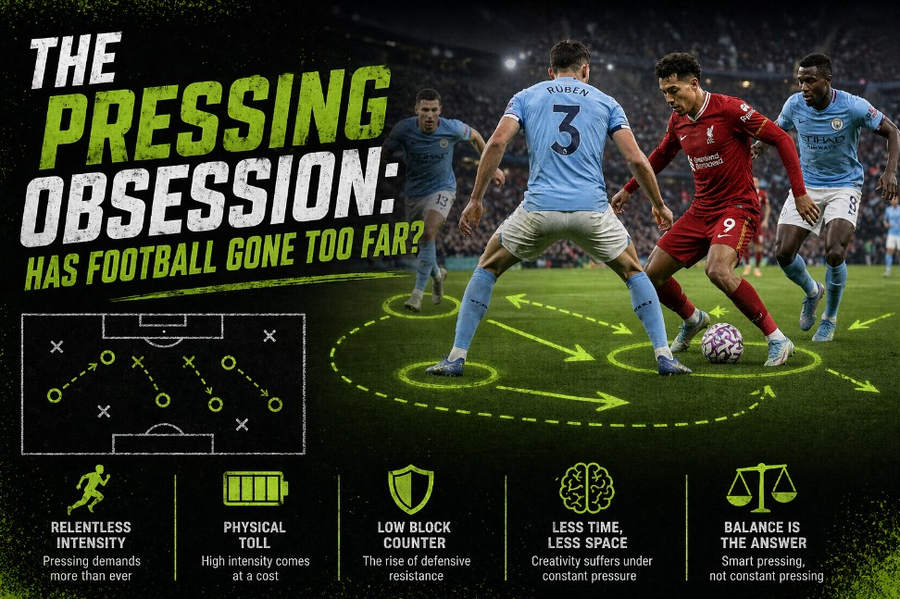
There was a time when pressing was a tactical choice. Now it feels like a requirement.
Watch almost any top-level match today and you’ll see the same pattern. The ball is played out from the back, the opposition swarm forward, passing lanes are cut off, and the goalkeeper is forced into a rushed decision. Win the ball high, create a chance, repeat.
It’s intense, it’s aggressive, and at its best, it’s brilliant to watch.
But the question worth asking now is simple: has football become too obsessed with pressing?
From Innovation To Default Setting
Pressing didn’t start as a universal tactic. It was an innovation—something that gave certain teams an edge.
Sides under Jürgen Klopp turned “gegenpressing” into a weapon. The idea was straightforward: lose the ball, win it back immediately while the opposition are still disorganised. It wasn’t just about defending—it was about attacking through chaos.
At the same time, teams influenced by Pep Guardiola used pressing as a way to control the game. Win the ball high, keep possession, suffocate the opponent.
Both approaches worked. Both were effective. And naturally, both were copied.
Fast forward a few years, and pressing isn’t a tactical edge anymore—it’s the baseline. If you’re not pressing, you’re seen as passive. If you sit off, you’re accused of lacking ambition.
That shift has changed the rhythm of the game entirely.
The Physical Demands Are Relentless
One of the most obvious consequences of this pressing obsession is the physical toll on players.
Modern footballers are expected to:
- Sprint repeatedly over short distances
- Close down defenders and goalkeepers
- Recover quickly when the press is broken
It’s not just forwards either. Midfielders and even defenders are now part of coordinated pressing systems that require constant movement and awareness.
The result is a game that’s faster and more intense than ever—but also one that pushes players to their limits.
You see it in the growing number of muscle injuries, the need for larger squads, and the increasing importance of rotation. Players aren’t just managing matches anymore—they’re managing workloads across an entire season.
And when fatigue sets in, the quality of decision-making often drops with it.
When Everyone Presses, What’s The Advantage?
Here’s where things start to level out.
Pressing works best when it’s unexpected or executed at a higher level than the opposition. But when every team is trying to do it, the advantage disappears.
Instead, you get:
- Predictable patterns of play
- Teams cancelling each other out
- Games decided by who executes the press slightly better rather than who plays better football
It becomes less about creativity and more about efficiency.
That’s not necessarily a bad thing, but it does change the nature of the sport. Matches can feel more like tactical battles of structure and spacing, rather than moments of individual brilliance.
The Rise Of The Low Block Response
Interestingly, the widespread use of pressing has led to a natural counter: the low block.
If teams know they’re going to be pressed high, one of the simplest ways to deal with it is to avoid building from the back altogether. Go long, bypass the press, and defend deep.
That’s why you now see more teams sitting compact, denying space, and forcing the opposition to break them down.
It’s not always pretty, but it’s effective.
And in a strange way, it highlights a flaw in the pressing obsession. If pressing is supposed to dominate games, why are so many teams finding success by doing the exact opposite?
Is Creativity Being Squeezed Out?
One of the more subtle effects of constant pressing is what it does to creativity.
When players are under relentless pressure, they have less time on the ball. Decisions have to be made quickly, often safely. Risk-taking becomes less attractive when losing possession can immediately lead to a dangerous situation.
That’s why you sometimes see:
- Fewer adventurous passes
- Less dribbling in tight areas
- More structured, system-driven play
It’s not that creative players don’t exist anymore—it’s that the environment they’re operating in is less forgiving.
You could argue that the game has become more efficient, but also more cautious in certain areas.
The Goalkeeper Factor
Another area where pressing has had a huge impact is the role of the goalkeeper.
Modern keepers are expected to be comfortable with the ball at their feet, almost like an extra outfield player. This is largely a response to pressing—if you’re being closed down high, you need someone who can help you play through it.
But this also introduces risk.
We’ve all seen goals conceded from mistakes while playing out from the back. The pressure is constant, and one wrong touch or pass can be punished instantly.
It raises an interesting question: are teams overcommitting to a style that looks good when it works, but exposes them unnecessarily when it doesn’t?
Not Every Team Is Built For It
One of the biggest issues with the pressing trend is how widely it’s been adopted, regardless of whether teams actually have the players to execute it properly.
High-level pressing requires:
- Organisation
- Fitness
- Tactical discipline
- Communication
Without those elements, it quickly turns into chaos.
You end up with players pressing individually rather than as a unit, gaps appearing all over the pitch, and opponents easily playing through the pressure.
In those situations, pressing becomes a weakness rather than a strength.
So, Has Football Gone Too Far?
This is where opinion comes in.
There’s no doubt that pressing has improved certain aspects of the game. It’s made matches more intense, increased the pace, and added a layer of tactical sophistication that wasn’t always there before.
But when something becomes the default, it also becomes predictable.
The best teams in football aren’t just the ones that press well—they’re the ones that know when not to press. They can switch between styles, adapt to different situations, and avoid becoming one-dimensional.
That’s the next step in the evolution.
Where The Game Might Be Heading
Football never stands still. If pressing continues to dominate, teams will keep finding ways to counter it.
We’re already seeing:
- More direct play to bypass pressure
- Tactical flexibility in pressing triggers
- Greater emphasis on ball retention under pressure
The game will adjust, as it always does.
And when it does, pressing might go back to being what it originally was—a powerful tool, rather than an all-consuming obsession.
The Bottom Line
Pressing isn’t the problem. It’s the overreliance on it.
When used intelligently, it’s one of the most effective tactics in football. But when every team tries to play the same way, the game risks losing some of its variety.
Football is at its best when there are different styles, different approaches, and different ways to win.
Right now, pressing dominates the conversation.
The real question is how long that lasts before something else takes its place.