
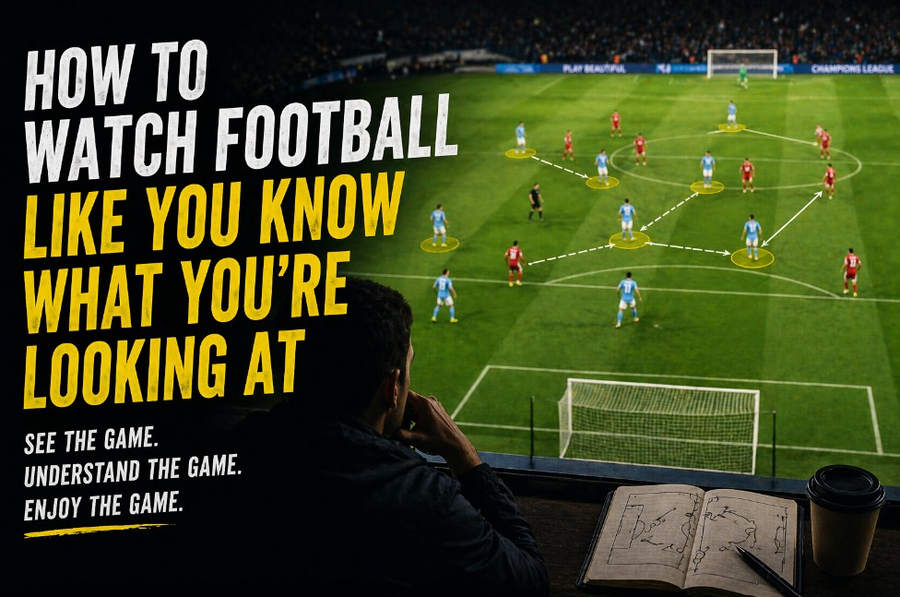
Most people watch football the same way.
They follow the ball, react to moments, and judge the game based on goals, chances, and the occasional bit of skill. There’s nothing wrong with that—it’s how most fans start.
But once you begin to understand what’s happening beyond the obvious, the game changes completely.
You start to see patterns. You notice why certain teams dominate without creating loads of chances. You understand why a player can have a “quiet” game and still be one of the most important players on the pitch.
Watching football properly isn’t about knowing everything. It’s about knowing where to look.
Stop Watching The Ball
This is the biggest shift you can make.
The ball draws your attention naturally. That’s where the action is, right?
Not always.
The most important movements in football often happen away from the ball. Players are constantly adjusting their positions—creating space, closing space, dragging defenders out of position.
If you only follow the ball, you miss all of that.
Try this during a match:
- Pick one player and watch them for a few minutes without focusing on the ball
- Look at how they move when their team has possession
- Notice what they do when they don’t
You’ll start to see how much work goes unnoticed.
Once you get used to that, the game feels less chaotic and more structured.
Look At Team Shape First
Before you think about individual players, look at the team.
When a side doesn’t have the ball, their shape tells you everything about their approach. Are they pressing high? Sitting deep? Staying compact?
When they do have the ball, watch how that shape changes.
Good teams don’t just spread out randomly. They create specific structures:
- Width from wingers
- Overloads in midfield
- Passing options at different angles
Spacing is key. If players are too close together, it’s easy to defend. If they’re positioned well, they stretch the opposition and create gaps.
You don’t need to know the exact formation. Just look at how organised—or disorganised—a team looks.
Spot The Pressing Triggers
Pressing isn’t random.
Teams don’t just run at the opposition for the sake of it. They press at specific moments—what are often called “triggers.”
These can include:
- A poor first touch
- A pass into a player facing their own goal
- A slow or predictable build-up
When that trigger happens, multiple players move at once. That’s what makes pressing effective—it’s coordinated.
Once you start looking for these moments, you’ll see them everywhere.
You’ll also notice the difference between good pressing and bad pressing. Good pressing looks controlled and deliberate. Bad pressing looks like players chasing shadows.
Watch The Midfield Battle
Most matches are decided in midfield, even if the goals come from elsewhere.
This is where teams:
- Control possession
- Break opposition lines
- Set the tempo
If one team consistently wins the midfield battle, they usually control the game.
Watch how midfielders position themselves:
- Are they receiving the ball under pressure?
- Are they finding space between the lines?
- Are they being forced backwards?
Also look at numbers. If one team has more players in central areas, they’re more likely to dominate possession.
This is why some teams can look comfortable without creating loads of chances—they’re controlling the game without necessarily finishing it.
Understand Transitions
Some of the most important moments in football happen right after possession changes.
This is what’s known as transition.
There are two key phases:
- When a team wins the ball
- When a team loses the ball
When a team wins possession, the opposition is often disorganised. That’s when quick attacks can be most dangerous.
When a team loses possession, their shape is often stretched. If they don’t react quickly, they’re vulnerable.
Watch what happens in the first few seconds after the ball changes hands:
- Do players react immediately?
- Do they press, drop back, or hold position?
The best teams are excellent in these moments. They either exploit space quickly or shut down the opposition before they can react.
Don’t Judge Players On Highlights Alone
One of the biggest mistakes fans make is judging players based on moments.
Goals, assists, skills—these are the things that stand out. But they don’t tell the full story.
A player can have a brilliant game without doing anything flashy.
Look for:
- Positioning
- Decision-making
- Movement off the ball
- Defensive work
For example, a forward might not score but constantly create space for others. A midfielder might not play the final pass but control the tempo of the game.
These contributions don’t always show up in highlights, but they matter.
Watch How Teams Create Space
Space is everything in football.
The team that uses space better usually wins.
There are a few common ways teams create it:
- Wide players stretching the pitch
- Midfielders making runs to pull defenders out of position
- Quick passing to shift the defensive block
Instead of focusing on where the ball is, look at where the space is.
When a goal is scored, it’s usually because space has been created somewhere—whether that’s a gap in defence, a mismatch, or a moment of disorganisation.
Once you start spotting that, goals make more sense.
Notice Patterns, Not Just Moments
Football isn’t just a series of random events. It’s full of patterns.
Teams repeat certain movements and combinations throughout a match:
- The same passing sequences
- The same runs
- The same pressing triggers
If you notice something happening once, watch for it again.
Good teams build their game around these patterns. They don’t rely on improvisation alone—they create situations they’ve practised over and over.
Recognising these patterns is what makes the game feel more predictable—in a good way.
You Don’t Need To Overcomplicate It
There’s a risk here.
Once you start analysing football more deeply, it’s easy to overthink everything. To turn every match into a tactical breakdown.
That’s not the point.
The goal isn’t to become a coach. It’s to enjoy the game more by understanding it better.
You don’t need to analyse every movement or identify every system. Just pick a few things to focus on:
- Team shape
- Off-the-ball movement
- Transitions
That alone will change how you see the game.
The Bottom Line
Watching football “properly” isn’t about knowing more than everyone else.
It’s about noticing more.
Once you stop focusing only on the ball and start paying attention to what’s happening around it, the game opens up. It becomes less about isolated moments and more about how those moments are created.
And the best part is, once you see it, you can’t unsee it.
The game doesn’t get more complicated—it gets clearer.